

The Typical American Home Just Hit 44 Years Old, and Maintenance Costs Run 76% Higher on Aging Houses
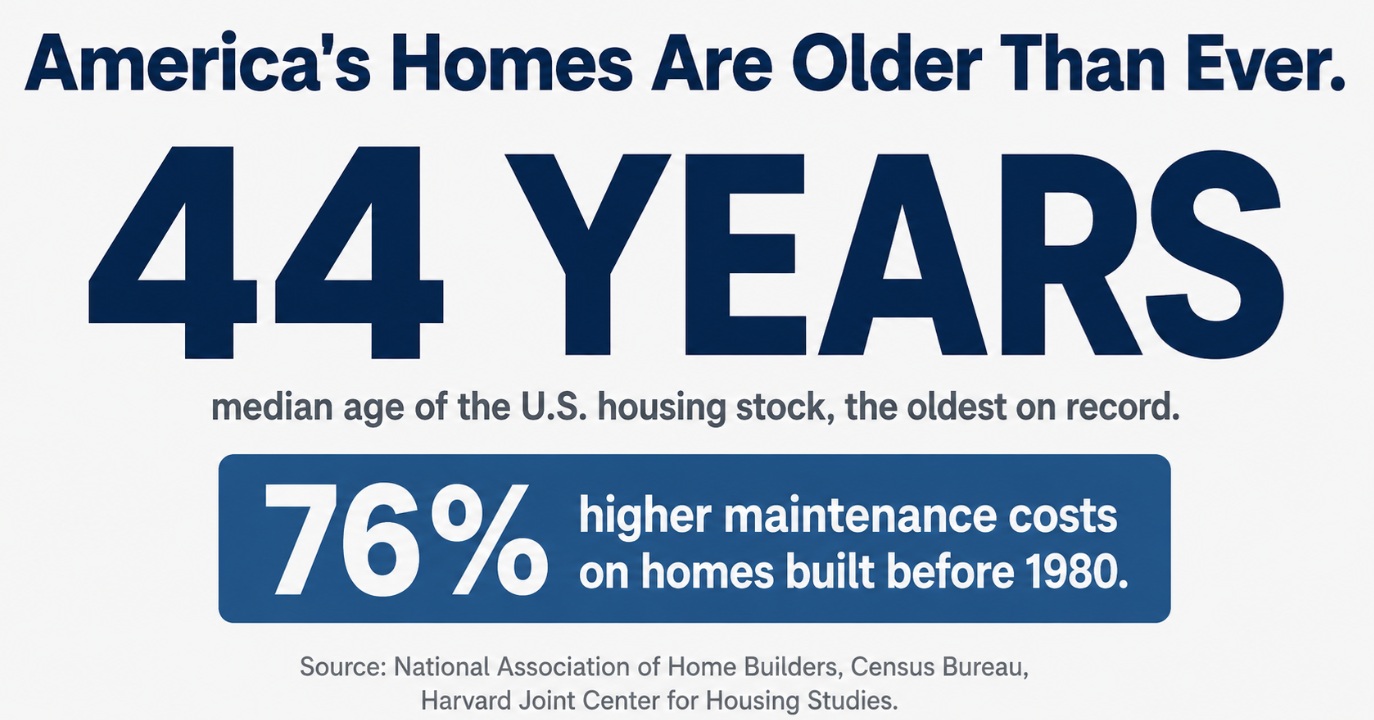
The median age of the U.S. housing stock reached 44 years, the oldest on record, while maintenance costs on homes built before 1980 run 76% higher than on newer homes.
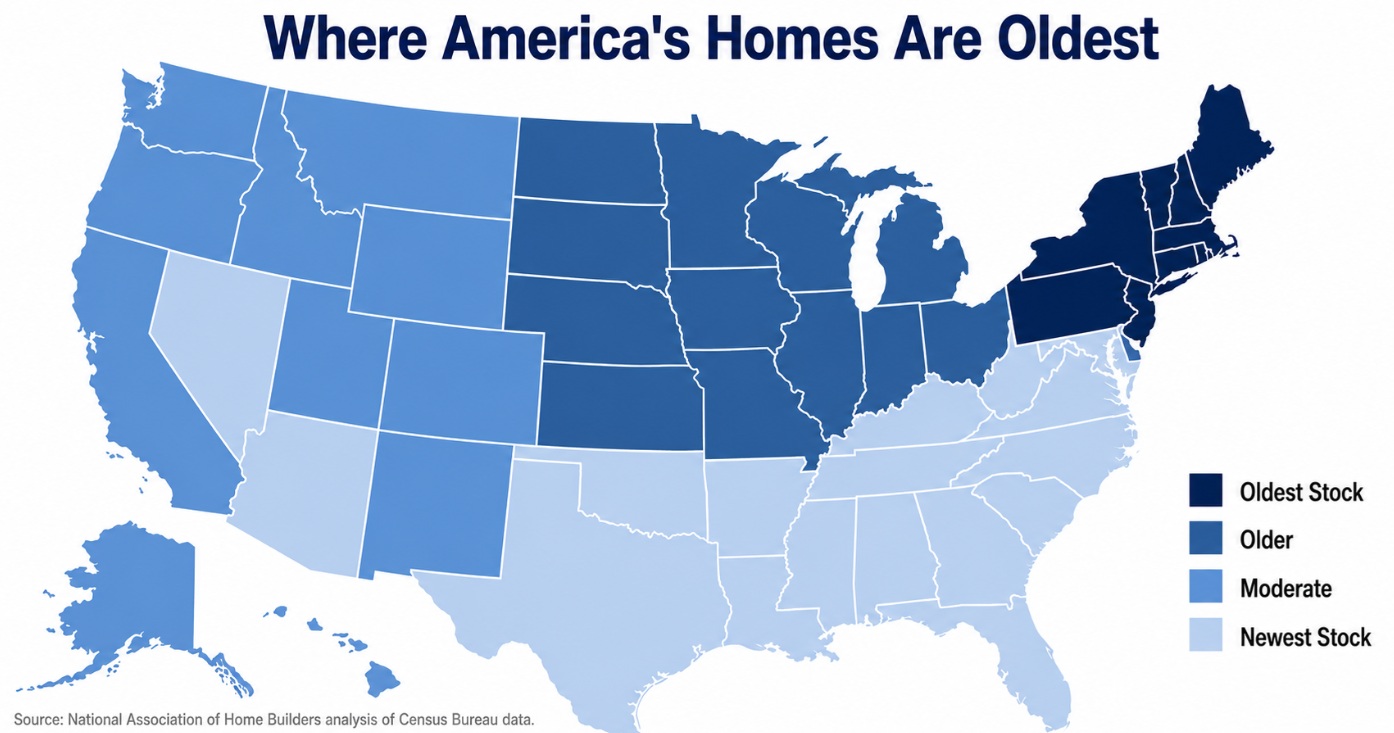
Housing stock is oldest across the Northeast and industrial Midwest, where states like New York and Pennsylvania carry homes well above the national median age, and newest across the Sun Belt.
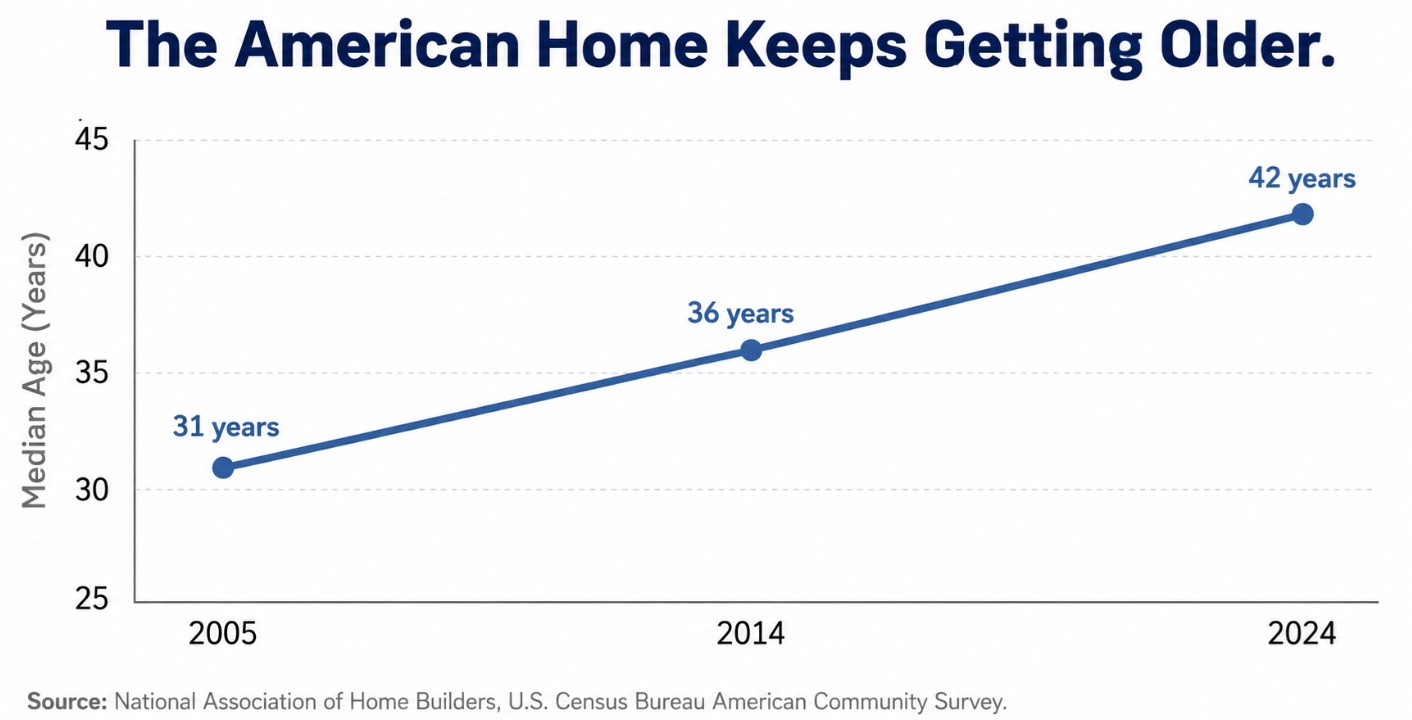
The median age of owner-occupied U.S. homes climbed from 31 years in 2005 to 42 years in 2024, the oldest on record.
Federal and Harvard data show the U.S. housing stock is older than ever, turning routine upkeep into a rising cost that reshapes what owning a home means.
Almost half the country's homes are now genuinely old. Census data analyzed by the National Association of Home Builders shows that around 47% of owner-occupied homes were built before 1980, and roughly 34% were built before 1970. The share of homes at least 45 years old has risen sharply, from 39% in 2014 to 47% in 2024. Nearly half of American homeowners now live in houses old enough that major systems such as roofs, furnaces, plumbing, and electrical components are increasingly approaching replacement age. As homes age, spending shifts away from cosmetic upgrades and toward necessary repairs that preserve safety and habitability.
Age carries a cost most buyers underestimate. Older homes are simply more expensive to keep standing. Research from the Harvard Joint Center for Housing Studies found that maintenance spending on homes built before 1980 runs 76% higher than on homes built since 2010, while improvement spending runs 24% higher. For the oldest homes, the gap is steeper still. Owners of homes built before 1940 spent an average of 6,700 dollars a year on improvements and repairs, roughly 50% more than owners of homes built after 2010.
What changes with age is not just the size of the bill but its nature. In newer homes, spending leans toward optional upgrades. In the oldest homes, it shifts to unavoidable replacements. The Harvard data found that replacements accounted for roughly half of all remodeling spending on homes built before 1940, a far larger share than in newer homes. A roof, a furnace, a water heater, and corroded plumbing all reach the end of their lifespans on a similar timeline, and an aging house tends to present those failures together rather than one at a time.
The pattern is sharpest in the older cities of the Northeast and the industrial Midwest. Census figures show New York has the oldest owner-occupied homes in the nation at a median age of 64 years, followed by Massachusetts and Rhode Island, both near 59. New York, Massachusetts, Rhode Island, Pennsylvania, and Vermont all have housing stock significantly older than the national median, a reflection of slower population growth and limited new construction. Western Pennsylvania shows the trend clearly. Pittsburgh and the surrounding river towns hold large numbers of homes built before World War II, many of them solid masonry structures that now need modern heating, roofing, and updated systems.
The aging story is not confined to the Rust Belt. The Sun Belt states that drew millions of residents in recent decades are now watching their own housing stock cross into the costly years. The newest homes sit in Nevada, where the median age is just 25 years, and Texas at 28 years. Yet much of that Sun Belt stock was built during the 1980s and 1990s, which means those houses are now 30 to 40 years old. Roofs installed a generation ago are reaching replacement age, and air conditioning systems running in hot climates wear out faster than equipment in milder regions. Even the newest markets are not far behind.
The financial weight of an aging home falls hardest on those least able to absorb it. Harvard found that homeowners in the lowest income quintile spent 16.3% of their income on repairs and maintenance in 2023. The highest earners spent just 3.7%. For an owner on a fixed budget, a single major replacement can arrive without warning and swallow a year of savings.
Across the country, the math is reshaping decisions. The United States contains roughly 146 million housing units, and the remodeling market has climbed above 600 billion dollars as owners pour money into keeping older houses functional. For many homeowners, the question is no longer whether an aging home will need significant work but when, and whether the timing lines up with their finances. Some owners choose to invest. Others, facing an inherited property or a house that has outrun their ability to maintain it, look for a faster exit.
The growing cost of maintaining older homes has also helped fuel demand for companies that buy houses as is. Buys Houses sees this aging infrastructure firsthand, working with homeowners across the Pittsburgh tri-state area who would rather sell an older or distressed property as is than pay to repair it first.
The age of America's housing stock has quietly become an economic story of its own. Price and interest rates dominate the headlines. The quieter trend is that the homes themselves are getting older, and that cost is landing on owners in every region. For home buyers and sellers alike, the year a house was built now matters almost as much as where it sits. For many owners, it comes down to a simple choice: keep paying to maintain an aging house, or sell and move on.
About Buys Houses
Buys Houses is a Pittsburgh-based cash home buying company serving Western Pennsylvania, including Allegheny, Washington, Beaver, and Westmoreland Counties. The company specializes in purchasing inherited, distressed, and as-is properties, offering homeowners a direct sale without repairs or delays. As one of the region's active cash home buyers in Pittsburgh, Buys Houses provides offers on properties in any condition. More information is available at BuysHouses.co or by calling 412-561-9833.
Carlo Finotti
Buys Houses
+1 412-561-9833
media@BuysHouses.co
Visit us on social media:
LinkedIn
Instagram
Facebook
YouTube
Other
Legal Disclaimer:
EIN Presswire provides this news content "as is" without warranty of any kind. We do not accept any responsibility or liability for the accuracy, content, images, videos, licenses, completeness, legality, or reliability of the information contained in this article. If you have any complaints or copyright issues related to this article, kindly contact the author above.
